
2026 Top Ten Issues Impacting Real Estate® – The Counselors of Real Estate®
The Counselors of Real Estate® (CRE®) have released their highly anticipated 2026 Top Ten Issues Affecting Real Estate®, providing a clear view into the challenges and forces shaping the commercial real estate landscape. This year’s report reflects a market navigating massive structural changes—from technological disruption to demographic shifts, capital challenges, and a prolonged period of economic uncertainty.
About The Counselors of Real Estate® — and Martin’s Leadership Excellence
The Counselors of Real Estate® (CRE®) is one of the industry’s most respected global organizations, composed of fewer than 1,000 real estate professionals worldwide who have demonstrated exceptional expertise, integrity, and leadership. Membership is invitation-only and recognizes individuals whose insight and judgment elevate the profession as a whole.
At Martin Commercial Properties, we are proud that our President & CEO, Van W. Martin, holds this esteemed CRE® designation. His inclusion in this elite group reflects the strategic thinking, deep market understanding, and unwavering commitment to client success that define Martin’s approach to service. It’s one more way our leadership demonstrates the trusted guidance and forward-looking perspective that has shaped our 62-year legacy.
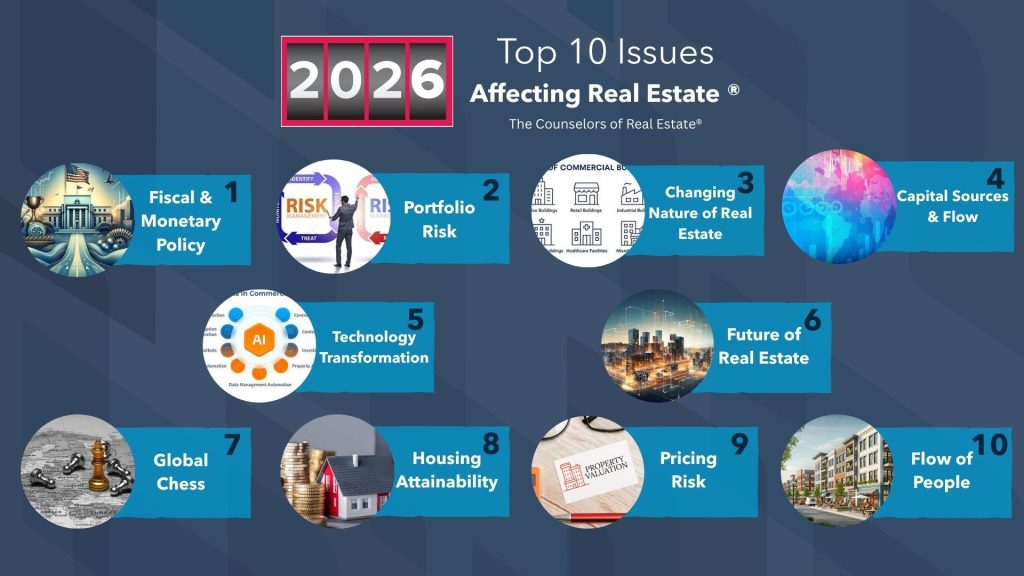
Below is a breakdown of the ten challenges shaping real estate decisions in 2026 and beyond.
1. Fiscal & Monetary Policy: Balancing Strength and Risk
Despite a staggering $37 trillion in national debt, the U.S. economy remains resilient. Job growth, consumer spending, and inflation have held up—yet elevated uncertainty, geopolitical risks, and delayed rate cuts continue to pressure real estate. With refinancing challenges and uneven sector performance, caution is warranted as the market adjusts to long-term fiscal and monetary headwinds.
2. Portfolio Risk: A New Era of Dynamic, Data-Driven Risk Management
Risk assessment has evolved far beyond the traditional annual review. Owners, lenders, and occupiers now face a complex landscape of infrastructure, climate, financial, and operational risks. With advanced analytics and real-time building data, risk management is becoming continuous and comprehensive—informing buy/sell decisions, capex planning, refinancing strategies, and tenant retention.
3. The Changing Nature of Real Estate: Back to the Fundamentals
The decades-long tailwind of cap rate compression has come to an end. Returns will depend on income performance—not financial engineering. Investors must refocus on fundamentals: strong underwriting, exceptional asset management, strategic leasing, and selecting the right building rather than the right sector. Operational discipline is now the key competitive advantage.
4. Capital Sources & Flows: Equity Is Scarce, Debt Remains Available
Transaction volume remains sluggish, trapping institutional equity in existing funds and limiting new capital. While the “gumming up” of equity flows presents short-term challenges, debt markets remain relatively liquid. Fundraising will require clearer value propositions, stronger strategies, and patience until valuations reset and liquidity returns.
5. Technology Transformation: AI Ushers in a Golden Age of CRE
AI is creating transformational efficiencies in underwriting, site selection, building operations, and decision-making. Data centers are booming as AI infrastructure expands, while property owners must secure data access and address cybersecurity vulnerabilities. With innovation moving at breakneck speed, CRE firms must adapt quickly—or risk being left behind.
6. The Future of Real Estate: Modern Thinking for a Data-Rich World
Real estate is entering a true golden age of data, computation, and analytics. Advances in AI, machine learning, and predictive tools are transforming how assets are valued, priced, and managed, enabling far more nuanced decision-making than in the past. To fully capitalize on these capabilities, real estate professionals must pair technology adoption with a shift in mindset—embracing modern statistical thinking, particularly Bayesian reasoning, to evaluate risk, update assumptions, and make disciplined decisions in an increasingly uncertain environment.
7. Global Chess: A Crisis of Confidence and Widespread Uncertainty
Unpredictable policy shifts, tariff volatility, declining transparency, and concerns about Federal Reserve independence are undermining economic stability and confidence. This environment of persistent volatility complicates long-term real estate decision-making on both the demand and capital sides. Even so, real estate’s inherent resilience—along with its long history of operating with imperfect information and relying on experienced judgment—positions the sector better than many asset classes to navigate prolonged uncertainty.
8. Housing Attainability: Friction Throughout the System
Housing affordability pressure now affects nearly every demographic group. Constraints such as restrictive zoning, high construction costs, and land scarcity have created deep-seated “stiction” across the housing ecosystem. Solutions to these challenges require incremental policy reform, public–private collaboration, and creative approaches at every step—from permitting to development to financing.
9. Pricing Risk: Debt Maturities Are Reshaping Value
With over $950 billion in loan maturities hitting annually through 2027, pricing risk is elevated. Distress is emerging gradually—not through a dramatic collapse but via slow workouts and selective discounts. As the bid–ask gap persists, holistic valuation methods are critical, incorporating access to infrastructure, resources, and workforce—not just physical assets.
10. Flow of People: Slowing Migration and Population Growth Change the Demand Map
Household formation, immigration, and domestic migration are all slowing, creating a more challenging environment for forecasting real estate demand. The once-booming Sun Belt is seeing plateaued inflows, while mobility is constrained by high mortgage rates and limited inventory. Developers must rethink assumptions about absorption, growth markets, and the “build it and they will come” model.
Let’s Talk About What This Means for Your Real Estate Strategy
The 2026 Top Ten Issues highlight a real estate landscape defined by change, complexity, and opportunity. Whether you’re evaluating portfolio risk, planning capital investments, or navigating market uncertainty, Martin Commercial Properties is here to help you translate insight into action.
Connect with our team to discuss how these trends may impact your portfolio or next real estate decision.